
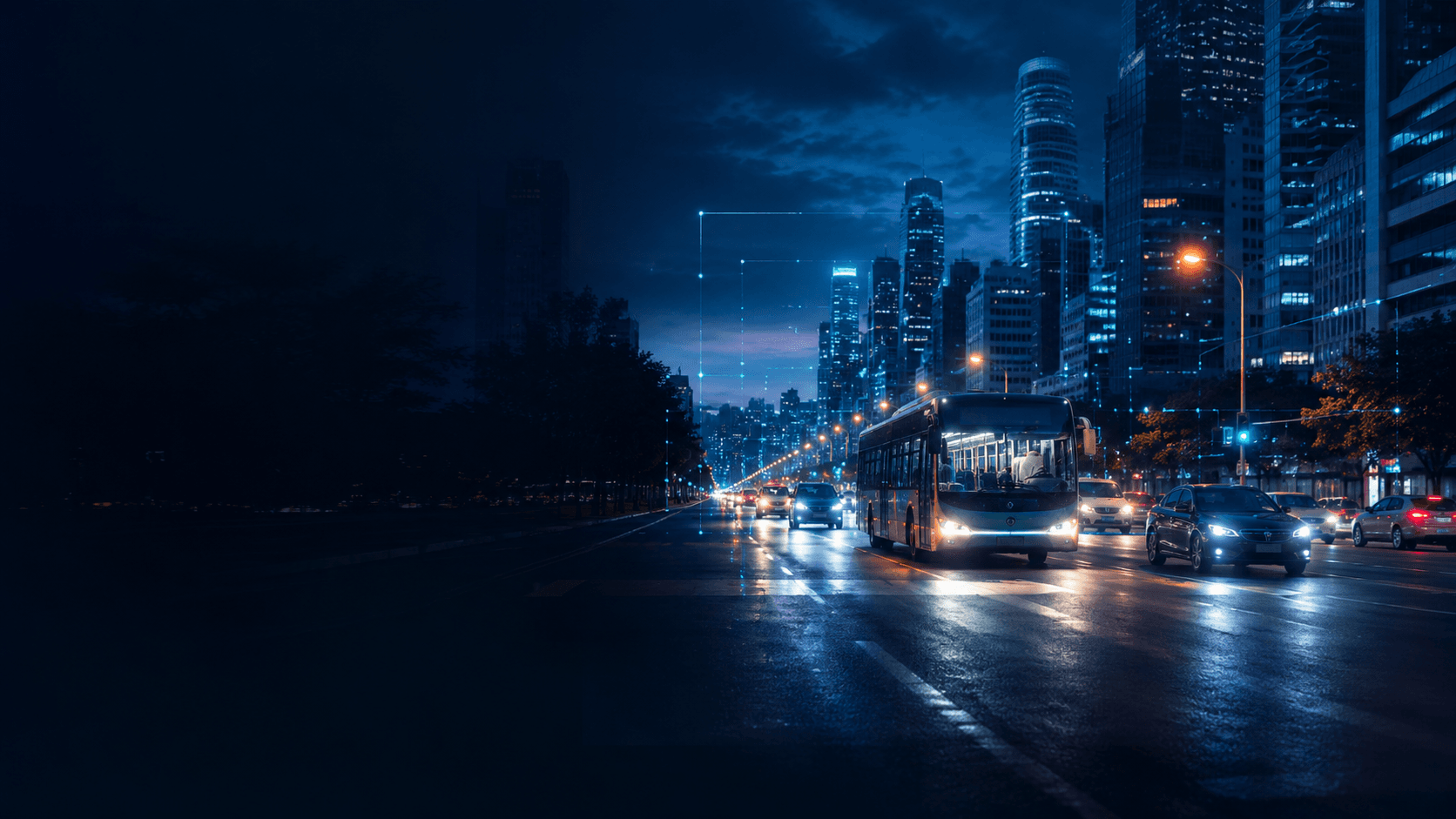
AI that catches violations while the bus moves
Edge-AI cameras on public transit buses detect traffic violations in real time — no fixed infrastructure, no government budget required.
Fixed cameras cover only a fraction of the road network — most violations go undetected simply because no camera is present.
2,203
Road fatalities (2024, Uzbekistan)
16,000,000
Traffic violations recorded (2024, Uzbekistan)
9,364
Accidents (2024, Uzbekistan)
The Solution
Edge AI on-board
On-board compute of ≥40 TOPS (tera-operations per second) runs detection models directly on the bus.
Mobile coverage
Every route, every hour the bus operates — not just fixed intersections.
Multi-violation detection
Stopping violations, red light violations, and pedestrian yield violations.
Real-time transmission
Evidence is transmitted over GPRS (general packet radio service)/4G to a cloud server as it's captured.
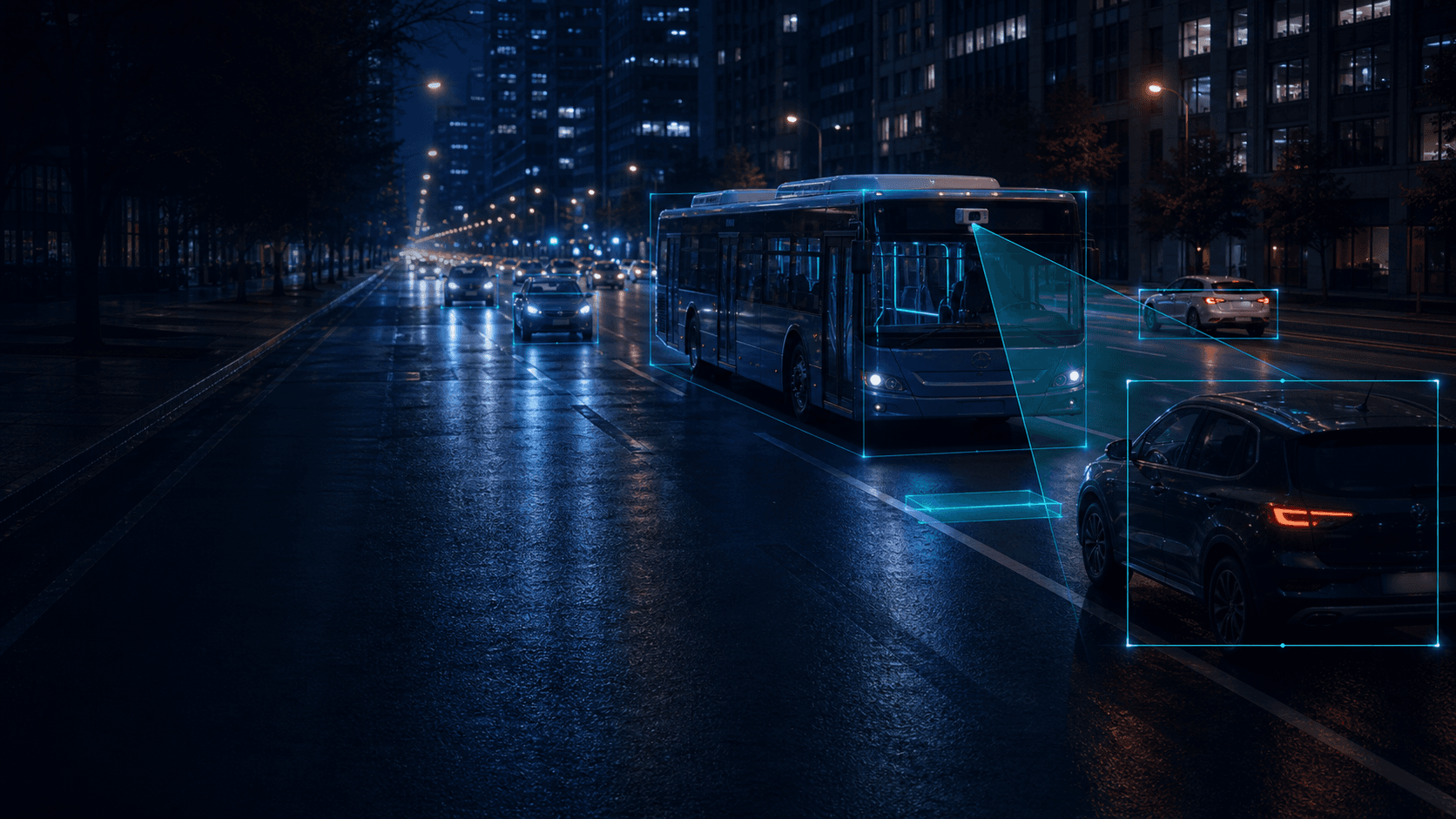
Mobile evidence layer
Moving buses become citywide enforcement coverage
A single on-board camera set can see violations, capture evidence, and route events for validation while buses continue normal service.
No fixed poles
Coverage moves with the fleet instead of depending only on intersections.
Evidence-first workflow
Detected events are packaged for human validation before enforcement routing.
Same hardware layer
The bus-mounted edge layer can support detection and analytics models.
How It Works
Detect
The on-board system detects a traffic violation in real time.
Validate
The on-board computer transmits evidence to the server for validation.
Route
First-time or preventable cases route to a driver warning; repeat or ignored cases are sent to the MIA fines system.
Potential Impact
All figures below are modeled projections, not results from a named deployment.
up to 75%
Reduction in targeted violation categories at full fleet deployment
up to $4.8M/mo
Combined potential enforcement revenue at 1,800-bus scale, per ПКМ-116 fine-distribution formula
$0
CAPEX required from government
≥93%
ANPR (automatic number-plate recognition) accuracy in standard conditions, ≥85% in night/adverse weather
Revenue Model
A modeled potential split at 1,800-bus scale. The government receives revenue without deploying a single dollar of budget. DriveLens guarantees $3,000,000 in private investment, plus service, maintenance, and MIA system integration.
Tashkent City Special Fund
Up to $2,400,000/mo
“Safe Road & Safe Pedestrian” Fund
Up to $960,000/mo
TSHTX (carrier)
Up to $1,443,000/mo
Roadmap
A generic phased deployment model, not tied to fixed calendar dates.
Pilot launch
20 buses
Results review
Evaluate pilot performance
Scale launch
1,800 buses
Scale results
Evaluate scale performance
Republic-wide rollout
Extend across the network
See BusAI in your city
Request a pilot proposal and start catching violations while the bus moves.